

Saudi Arabia Visa: eVisa, Requirements and Entry Rules
Around 65 passports can apply online for a Saudi eVisa before flying. Holders of a used, valid US, UK or Schengen visa, and residents of those places or the GCC, can instead get a visa on arrival. Citizens of other Gulf Cooperation Council states travel visa-free with their national ID, and everyone else applies at a Saudi embassy or consulate.
- e-Visa for 248 passports
- Government fee from $152
- Verified
Plusvisa is a private visa application service, not a government agency or embassy. Official government source: Saudi eVisa portal, visa.visitsaudi.com.
Do you need a visa for Saudi Arabia?
Which route applies depends on nationality, and on any valid US, UK or Schengen visa already in the passport.
Which passport will you travel on?
Your route
Pick a passport
We will show the route Saudi Arabia puts you on, the government fee for each visa type, and the guide written for your nationality.
The four routes
- e-Visa eligible
248 passports
Citizens of a set list of countries across Europe, North America, East and Southeast Asia, and a few in Africa and Oceania, can apply online before flying and skip the embassy.
- Visa on arrival
Visa on arrival
Travellers holding a valid, already-used US, UK or Schengen visa, or who are permanent residents of the US, UK, EU or a GCC country, can get a visa at the airport or another entry point on arrival, without applying first.
- Visa-free
No visa needed
Citizens of the other Gulf Cooperation Council states travel to Saudi Arabia without a visa, using their national ID card.
- Embassy visa only
Apply at an embassy
Travellers who are not covered by the groups above must apply for a visa at the nearest Saudi embassy or consulate before travelling.
Government fees by passport
| Passport | Tourist E-visa | Guide |
|---|---|---|
| United Kingdom | $152 | Read guide |
| United States | $152 | Read guide |
| Canada | $152 | Read guide |
| Australia | $152 | — |
| Ireland | $152 | — |
| Germany | $152 | — |
| Azerbaijan | $152 | Read guide |
Which Saudi Arabia visa exists, and what it allows
| e-Visa | Options | Processing | Usual government fee |
|---|---|---|---|
| Tourist E-visaeVisa · 248 passports |
| 3–60 business days | $152 |
How Saudi Arabia visa fees work

Set by the government. The eVisa fee is set by Saudi Arabia's Ministry of Tourism and charged in Saudi riyals. It can change at any time at the ministry's discretion.

VAT included. Value added tax at the applicable rate is added to the eVisa fee as part of the checkout price on the official portal.

No refunds. Once an eVisa application is submitted it cannot be cancelled. If an application is unsuccessful, or the visa is never used, the fee is not refunded.

Visa on arrival is paid at the border. Travellers using the visa-on-arrival route pay the government fee at the airport, land or sea checkpoint, not through the online portal.
What Plusvisa charges
The government fee is passed through at cost. Our service fee is on top, and every passport's page shows the total before you start.
If we make a mistake that leads to a refusal, we refund our fee and re-apply free.
See the total for my passportYour document checklist

Passport
Must be valid for at least 6 months from the date of entry, and the same passport used for the application must be presented at the border.

Digital photo
200 x 200 pixels, 5 to 100 KB, plain white background, no other people or objects, face filling 70 to 80 percent of the frame, taken within the last 6 months.

Valid email address
Used to create the account and to receive the issued eVisa as an attachment.
Only for some travellers

Return or onward ticket
Only if Applicants from embassy-route countries. Proof of a return or onward flight, not required from citizens of e-Visa eligible countries but usually asked for at an embassy.Proof of accommodation
Only if Applicants from embassy-route countries. Hotel booking or invitation showing where the applicant will stay, not required from citizens of e-Visa eligible countries.Proof of funds
Only if Applicants from embassy-route countries. A recent bank statement or similar evidence that the traveller can support themselves during the stay.Valid US, UK or Schengen visa
Only if Visa-on-arrival applicants who are not from an e-Visa eligible country. Must already have been used at least once, shown by an entry stamp from the issuing country, in the same passport.
Not eligible for any e-Visa
The application, step by step
Before you apply
- 1
Check eligibility
Confirm which route applies: e-Visa, visa on arrival, or an embassy visa, based on nationality and any valid US, UK or Schengen visa already held.
- 2
Prepare documents
Have a passport valid for at least 6 months, a digital photo meeting the official specification, and an email address ready.
On the official portal
- 3
Create an account
Register on the official eVisa portal with an email address and verify it.
- 4
Complete the application
Enter passport and personal details, upload the photo, and answer the eligibility questions.
- 5
Pay the fee
Pay the government fee online by card; VAT is added at checkout.
After you apply
- 6
Receive the eVisa by email
If approved, the eVisa is sent as an email attachment. Keep a copy, printed or digital, to show on arrival.
- 7
Present it on arrival
Arrive on the same passport used in the application. Biometric details are captured by immigration on entry.
What your Saudi Arabia visa looks like
Each part of the visa you receive, and what it means for your trip. Choose a label to read about it.
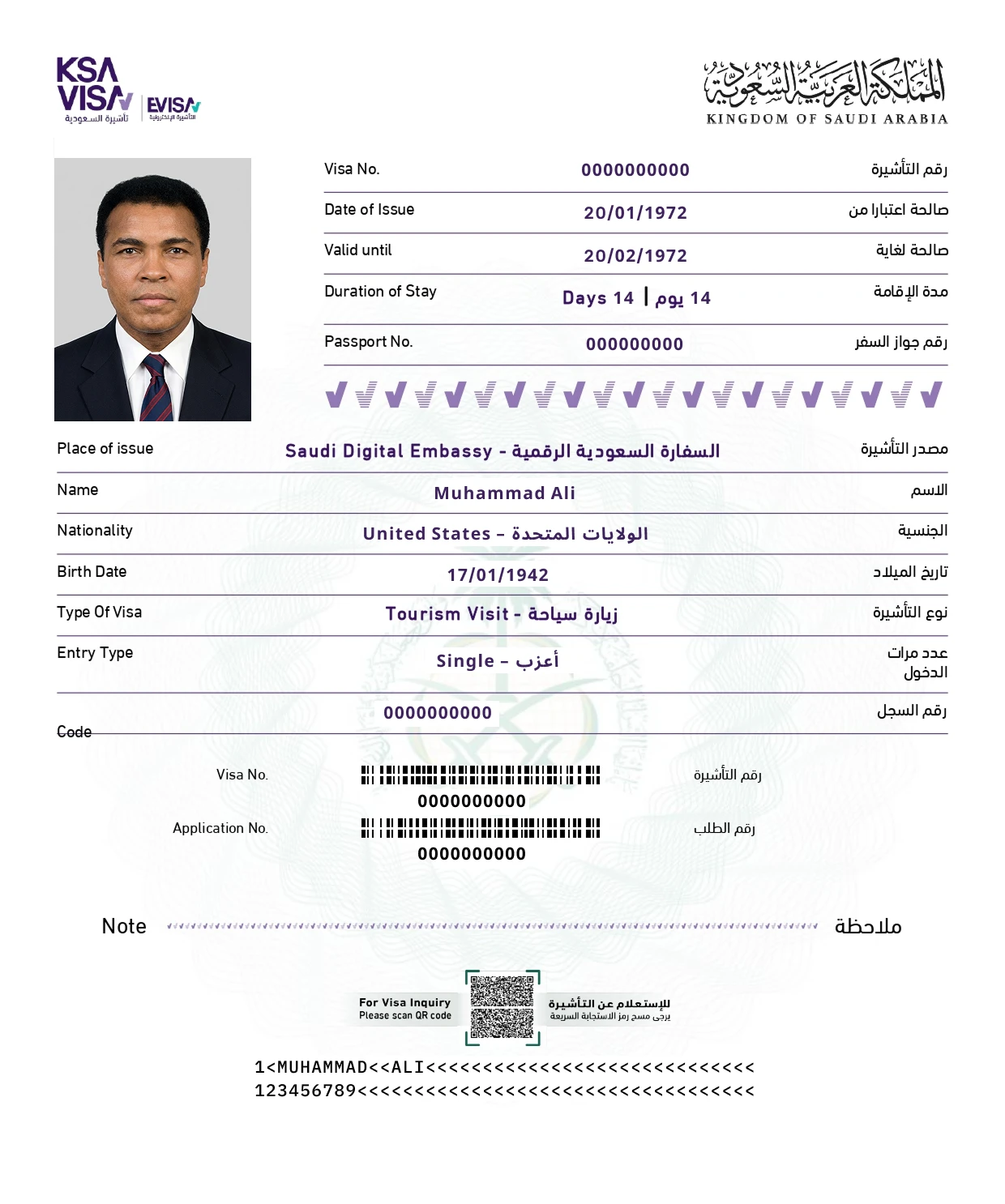
Example with fake data. Your visa will show your own details.
- 1
Issuing authority
Shows the KSA Visa / eVisa logo and the Kingdom of Saudi Arabia emblem, confirming this visa was issued through the official Saudi Digital Embassy e-visa system.
- 2
Your photo
The passport-style photo of the visa holder, used to visually match the traveller to this visa at border control.
- 3
Validity and stay
States the visa number, when it was issued, when it expires, and how long you may stay per visit, along with your passport number. Here the visa is valid from 20/01/1972 to 20/02/1972, allowing a stay of up to 14 days.
- Visa No.:
- Unique number identifying this visa.
- Date of Issue:
- The date the visa became valid.
- Valid until:
- The last date the visa can be used to enter or stay.
- Duration of Stay:
- Maximum number of days you may remain in Saudi Arabia per visit.
- Passport No.:
- The passport number this visa is linked to; must match the traveller's passport.
- 4
Place of issue
Identifies the office that issued the visa, here the 'Saudi Digital Embassy', confirming it was processed through the online e-visa platform.
- Place of issue:
- The authority that granted the visa.
- 5
Personal details
Your name, nationality and date of birth as recorded on the visa; these must match your passport exactly for the visa to be valid.
- Name:
- Full name of the visa holder.
- Nationality:
- The traveller's citizenship.
- Birth Date:
- The traveller's date of birth.
- 6
Visa type and entries
Specifies the purpose of travel and how many times the visa can be used. This sample shows a Tourism Visit visa allowing a Single entry into Saudi Arabia.
- Type Of Visa:
- The purpose for which the visa was granted.
- Entry Type:
- Whether the visa allows one entry or multiple entries into the country.
- 7
Record number
An internal record/registration number associated with this visa application, used by Saudi authorities for tracking purposes.
- Code / Record Number:
- Internal reference number for this visa record.
- 8
Verification barcodes
Two scannable barcodes encoding the Visa Number and Application Number, allowing border officials or systems to quickly verify the visa electronically.
- Visa No. barcode:
- Machine-readable version of the visa number.
- Application No. barcode:
- Machine-readable version of the application number.
- 9
Notes area
A blank or decorative line reserved for any additional remarks from the issuing authority; empty on this sample.
- 10
Verification QR code
Scan this QR code to quickly check the visa's status or authenticity online, as indicated by the 'For Visa Inquiry' text.
- 11
Machine-readable zone
The standardized machine-readable lines encoding the holder's name and document numbers, scanned automatically by passport-reading machines at immigration.
- MRZ line 1:
- Encodes the holder's name in machine-readable format.
- MRZ line 2:
- Encodes additional document identifiers for automated scanning.
The only official website, and how to check status
Run by Saudi Arabia's Ministry of Tourism, this is the only official site for the tourist eVisa. Any other website offering to arrange it is a private service, not a government one.
visa.visitsaudi.com (opens in a new tab)Saudi eVisa portalChecking your status
Log back into the account used to apply on the eVisa portal to see the application's status; an approved eVisa is also emailed as an attachment.
Why Saudi Arabia e-Visas get rejected
Almost every refusal is a file problem, not a judgement about you.
Passport not valid long enough
An application will not be accepted unless the passport has at least 6 months left from the date of entry to Saudi Arabia.
False or misleading information
Any application containing information that does not match the passport, or is otherwise inaccurate, is rejected.

Wrong route for the nationality
Applying for an eVisa or visa on arrival when the passport is not on the eligible list, or does not carry a valid, used US, UK or Schengen visa, leads to refusal.

Photo does not meet the specification
A photo that is the wrong size, has a coloured or patterned background, shows more than one person, or is more than 6 months old is a common reason applications are sent back.
Discretion of the immigration officer
Holding an eVisa does not guarantee entry. Final entry is decided by the immigration officer at the border, based on the conditions met on arrival.
Sockets and power in Saudi Arabia
Type G
Three flat pins · 13 A
Type G
Saudi Arabia uses type G sockets. If your own plugs are a different type, one type G adapter covers the whole trip.
Voltage
230 V · 60 Hz
Check the label on chargers and appliances: anything marked 100–240 V, 50/60 Hz works here with only an adapter, no converter.

Pack: a type G adapter unless your own plugs already match, and a small power strip — hotel rooms rarely have more than two sockets.
Saudi Arabia drives on the right
Traffic side:
Saudi Arabia · right-hand traffic

Getting around
Riyadh has a metro and bus network; Jeddah and other cities rely on taxis and ride-hailing apps such as Uber and Careem. Car hire is easy and common for trips between cities and to sites like AlUla.

Heat and health
Summers are extremely hot, with daytime highs above 40C from May to September. Carry water, limit time outdoors at midday, and use sun protection, especially away from the coast.

Dress and etiquette
Modest dress is expected for everyone in public: shoulders and knees covered. Alcohol is illegal. Public life pauses briefly at prayer times, when some shops and restaurants close for a short while.
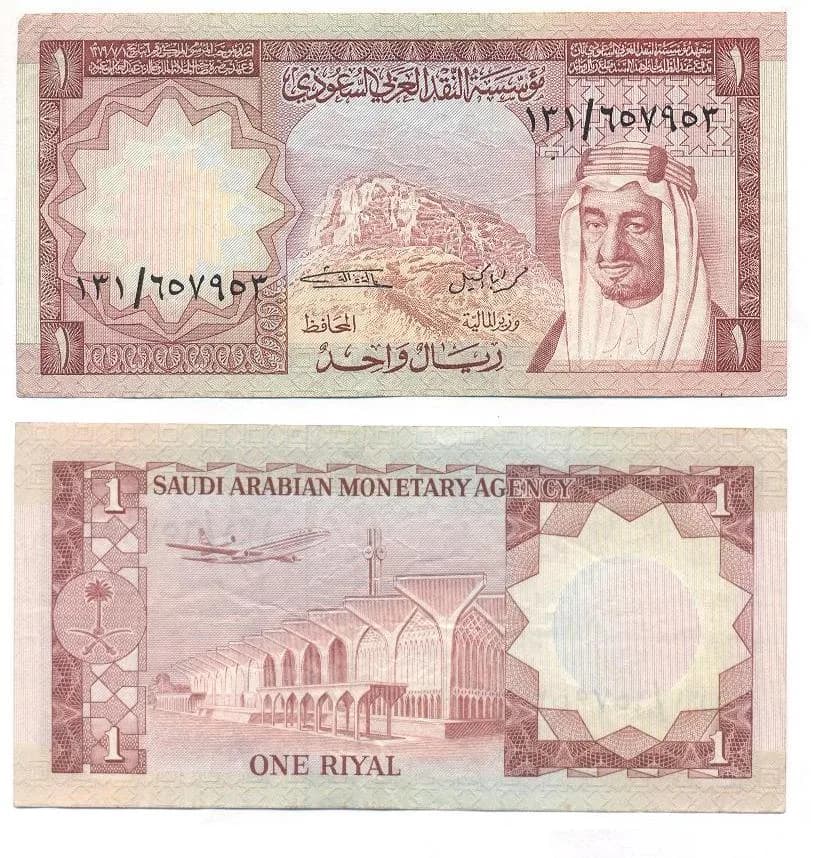
Saudi Riyals, cash and cards
Saudi Arabia uses the Saudi Riyal (SAR).
$1 ≈ SAR3.7 · indicative mid-market rate, possibly a few days old

Cards work almost everywhere
Bank cards and mobile payments are accepted in most shops, hotels and restaurants in cities, so carrying large amounts of cash is rarely necessary.

Keep small notes for cash tips
Riyal notes are still useful for tipping porters, valets and drivers, and for small vendors and traditional markets that prefer cash.

ATMs are widely available
Cash machines are common in airports, malls and city centres and accept most international bank cards, but can be scarcer in small towns and rural areas.
Weather by month (Riyadh)
- Daytime high
- Grey row = night low
- Best time to go
- Daytime high
- Grey row = night low
- Best time to go
| Month | High, °C | Low, °C | Rain, mm |
|---|---|---|---|
| January · best | 21 | 6.6 | 5.6 |
| February · best | 24.3 | 8.9 | 3.7 |
| March · best | 29 | 13.4 | 2.5 |
| April | 34.3 | 18.8 | 5.4 |
| May | 40 | 24 | 0.9 |
| June | 42.8 | 26.2 | 0 |
| July | 44 | 28 | 0 |
| August | 43.5 | 27.9 | 0 |
| September | 40.2 | 24.5 | 0 |
| October | 34.5 | 19.7 | 0.3 |
| November · best | 27.1 | 13.8 | 6.9 |
| December · best | 21.9 | 8.3 | 6.2 |
Monthly averages. Source: NASA POWER climatology, 2001-2020.
January · ideal
The best window runs January, February, March, November and December.
High 21°CLow 6.6°CRain 5.6 mm
Sweet spot: Riyadh has a hot desert climate. Winters, from November to March, are mild and pleasant with cool nights. Summers, from May to September, are extremely hot and dry, often above 40C. Rain is rare year-round.
Tipping in Saudi Arabia
SAR 60($16)
Restaurant bill
Only if a service charge is not already added to the bill.
10–15%
on a SAR 60 bill: SAR 6 · $1.60
Cafe or casual meal
Rounding up the bill is common.
SAR 5–SAR 10
$1.33–$2.67
Hotel porter, per bag
SAR 5–SAR 10
$1.33–$2.67
Housekeeping, per night
SAR 10–SAR 15
$2.67–$4
Taxi or rideshare
Rounding up the fare is the usual practice.
0–10%
on a SAR 60 bill: SAR 0 · $0
Tour guide, per day
SAR 50–SAR 100
$13.33–$26.67
Private driver, per day
SAR 30–SAR 50
$8–$13.33
SIM, eSIM or roaming?
Local SIM
Local SIM card
≈ $26.67SAR 100
STC, Zain or Mobily counters at the airport, or their stores in cities Passport required to register the SIM at the point of sale.
eSIM
RecommendedTravel eSIM
≈ $15
International eSIM providers, bought online before departure Installs before landing, useful if travelling without a physical SIM slot to spare.
Roaming
Roaming from home
Home mobile operator, activated before departure Usually the most expensive option; check the operator's Saudi Arabia roaming rate first.
If it's your first time: three you shouldn't skip
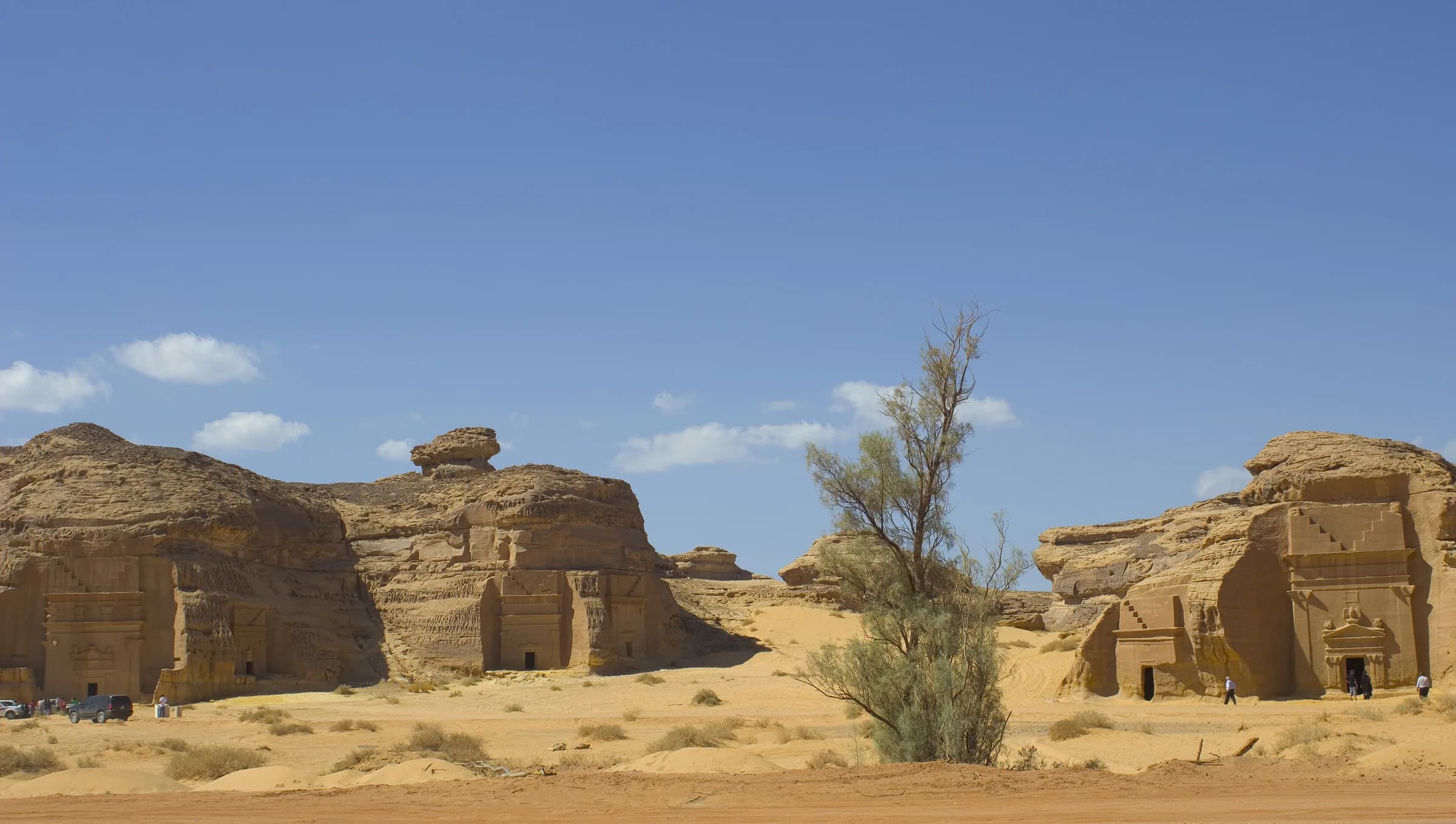
AlUla
Hegra (AlUla)
Saudi Arabia's first UNESCO World Heritage Site, with tombs carved into sandstone by the Nabataeans over 2,000 years ago.

Diriyah
At-Turaif District
The mud-brick birthplace of the first Saudi state, on the edge of Riyadh, now restored as a UNESCO-listed walking district.

Jeddah
Al-Balad Historic District
Jeddah's old town of coral-stone houses and wooden balconies, once the gateway for pilgrims arriving by sea.
Questions everyone asks about Saudi Arabia visas
Most travellers need either an e-Visa, a visa on arrival, or a visa from a Saudi embassy, depending on their passport. Citizens of other Gulf Cooperation Council states can enter without a visa using their national ID.
The eVisa allows stays of up to 90 days per visit, and is valid for multiple entries over one year from the date it is issued.
Yes. The tourist eVisa can be used for Umrah outside the Hajj season, as well as for tourism, leisure and visiting family.
No. Non-Muslims are not permitted to enter the central areas of Mecca and Medina, whatever visa they hold.
General tourist entry does not require proof of insurance, though some transit and Umrah routes carry a mandatory medical insurance requirement, so it is worth checking the route used.
No. The sale and consumption of alcohol is illegal for residents and visitors alike.
Modest dress covering the shoulders and knees is expected in public for everyone. There is no legal requirement for foreign women to wear an abaya, though loose, modest clothing is recommended.
Many visitors can hire a car using a valid foreign or international driving licence, but rules vary by nationality, so check with the car hire company before travelling.
Now read the one written for your passport
Each guide has the fee for that passport, its maximum stay, the rules that apply only to it, and the application itself.